Sunday, April 25, 2010

INJURY REPORT! The First Casualties of the Gardening Season!

When “Gan-Green Thumb” and I planted our garden this year, we knew that there would be problems, but we didn’t know that they would come so soon! As you know, at last report, things were going well, but sadly, there are injuries, and possible casualties, in our garden. Come view the sad evidence with us:


The first thing that struck me was the condition of the grapevines. What on earth could have happened here:


“This looks like the work of Molly Hatchet, aka: ‘The Golden Marauder’!”


“I’d be willing to bet on it!”


“It looks like the Golden Marauder struck the raspberry bush, too! Absolutely diabolical!”


“I don’t think the Golden Marauder did this. It might be time to do a little spraying!”


Is anything going right in the garden? The lone blackberry bush, safely out of reach, seems to be doing okay:


They Old Coot’s experiments seem to be doing alright, too:


The strawberries and tomatoes are growing:


The corn and black-eyed peas have popped up, but I think that they were planted to far apart to qualify for “companion planting” (I never get anything right on the first try!). The marigolds are good and stinky, and hopefully will keep the Mexican bean beetle at bay:


The blueberries actually look like blueberries now:


Yet, the Golden Marauder continues to do her dastardly deeds. Here she is with some of her newest handiwork:


I have a feeling that if we actually were to have to live off of what we could grow, we might just starve to death!

Tuesday, April 13, 2010

Ready…Set…Garden!

It’s that time of year again…”Gan-Green Thumb” and I are ready to start gardening. Gardening in Texas can be tricky; you have to plant your vegetables late enough that they are not in danger of frost (and here you never really know when the last frost will be), but you also have to plant them early enough that you can harvest them before the fire of Texas summer burns up the whole yard. This will be our third year to garden. Our first year was pretty much a wash-out (“Gan-Green Thumb” started way too late), and although last year was better, we still have a long way to go. But we are excited and ready to get going on this year’s garden and put to use all of those books that we have read.

There is a new threat to this year’s garden, however, and it is even more destructive than the “Gan-Green Thumb”: Molly-Anna Marie. She’s our new golden retriever puppy.


Yes, she’s cute, and oh-so-soft, but when it comes to plant life, she can tear out a newly planted violet in record time. She also loves to dig in the square foot gardens and stomp all over EVERYTHING! We will see how much suffering is caused in the days to come!

I have eagerly awaited the return of my four beloved blue berry bushes. I bought them year-before-last, and they were just tiny twigs (I had read on the internet that it was best to have two different varieties). Knowing that they liked soil that was more acidic, I planted them in pots with a mixture that was about 1/3 potting soil and 2/3 peat moss (give or take a little). I also give them a little shot of azalea food now and then. They have done so well! In fact, they have done so very well that they really are outgrowing their pots. Where we are going to plant them is still under much discussion, but they definitely need a new home soon:


I had ordered something called the Hansen bush cherry last year, which I have since read is not that great. However, here it is, and two of the three plants that I ordered actually survived the winter. It is another little critter that will need to come out of the pot before next year (I think I may need to buy some acreage!).


Miss Molly-Anna has done quite a number on my young grape vines, chewing some of the branches off at the base, but there is a little bit left, and they are looking pretty good:


One thing about which I am really excited is that this is the first year we have had a dedicated garden spot (besides the square foot gardens). I learned in a gardening class that tomatoes and peppers really do better if they have some room. I'm thinking that corn will probably like some room, too! The Old Coot Who Married Me borrowed a tiller from a friend and tilled up a little area in the back:


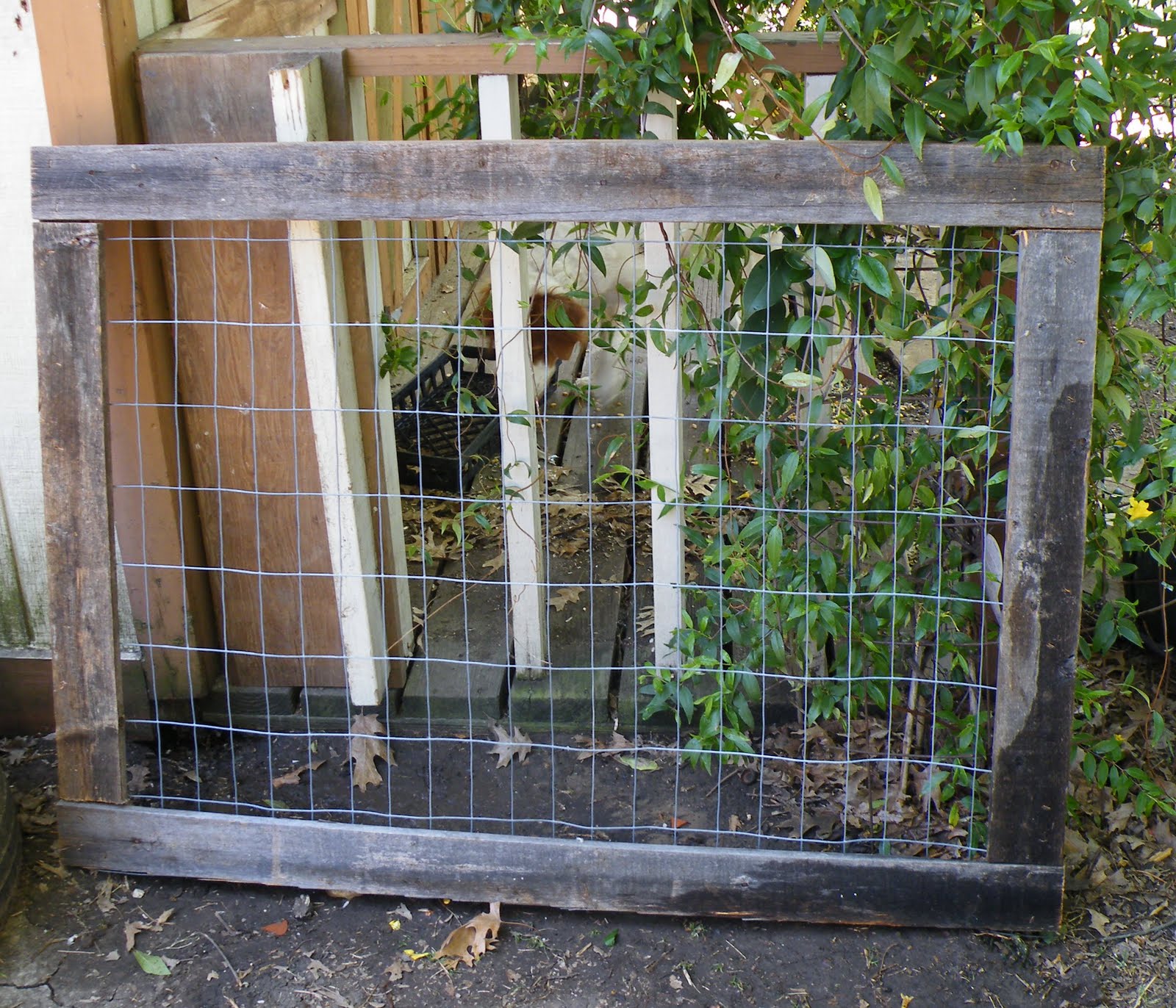
He has even been working on a simple little fence (to protect from golden-haired marauders). It will also be used as a trellis for the cucumbers and zucchini that I planted next to it:


The gate has been built, and is ready to be mounted:


The square foot gardens are still intact, and my raspberries are looking like they might need a little more “foot-space”. We are hoping to find an old, antique style bath tub or a stock tank to plant them in, because we have learned that they will take over the whole yard if they are not contained at all!


Since we absolutely LOVE strawberries, I decided to dedicate one of the square foot gardens to them, with enough room to run (I hope!):


The Old Coot Who Married Me has some experiments of his own going, including something that he calls “vertical gardening”:


My bell peppers are okay so far:


And I even have some little tomatoes starting:


This may look like some terrible dirt, and I admit that we have a few more years of amending this soil to get it in shape, but this is actually a row of corn with a row of black-eyed peas planted directly in front of it:


I am trying something called “companion planting” which is a concept put out by the book, “Carrots Love Tomatoes: Secrets of Companion Planting for Successful Gardening” by Louise Riotte. The idea behind this book is that certain plants do well when planted with other plants. Supposedly, the black-eyed peas will provide the corn with needed nitrogen, while the corn stalks will provide support for the peas to climb. I will later plant some marigolds among all of this, which are supposed to repel the Mexican bean beetle. Those little critters did a real number on our peas last year, and I was angry! If the marigolds don’t work, I will see if I can get some DDT or a flame thrower! (You don’t mess with a Southerner’s black-eyed peas!)

Here are more “Old Coot” experiments (our soil here is awful!):


And here are my compost bins:


I wish I could have the compost set-up that is recommended by the “Dirt Doctor”, but it is an open system and we have had too much trouble with mice around the green house, and they don’t need to be fed any more than they already are! The large green barrel is a compost bin that I ordered a couple of years ago. It does everything that it claims to do, and it was easy to assemble. However, for those who are budget-minded, a trash can with some holes drilled in it (as seen on the left of the picture) is almost as good. I have enjoyed having compost bins – between my recycling efforts and my composting efforts, the amount of trash that we set at the curb each week has been reduced significantly. However, my compost does not seem to “cook” as fast as I would like, and I obviously have more to learn before I am a “master composter”! I had to buy compost this year, which did not make me happy, but compost is not only a natural way to fertilize your soil, it can actually help to change the texture of that awful, clumpy soil that we have (over time). There is a website that I found that is dedicated to composting, and I will be spending some time there!

Once again we have cute little peaches making an appearance!


Will the birds and squirrels get them all, like they did last year? Will the mocking birds eat all of the blue berries once again? Will “Gan-Green Thumb” lose the battle with the Mexican bean beetle this summer? Will Molly-Anna Marie just take the whole garden out, saving us the struggle? Check back in a few weeks for answers to these burning questions!

Wednesday, March 10, 2010

A Call For Help!

This blog is all about various aspects of emergency preparedness: food storage, gardening, basic preparedness skills, etc. But unfortunately, there are some things in life for which nothing will prepare you.

It has recently come to my attention that there is a little girl, only 11 months old, who is battling stage 4 cancer. This family needs all of the help and support that they can get! If you are interested in learning more about Penelope (Penny), then please visit the family's website:

http://pennies4penny.org/

Thanks!

Monday, February 22, 2010

Website Alert! "Dinner in a Jar"?

The Old Coot Who Married Me is a member of an amateur radio group, and last Saturday night there was a group social. Since The Old Coot was in charge of the social, I decided that it was important for me to attend as well, mostly to support him. I was so glad that I went! My Friends Jay and Lauren were both there, and as always, it was so great to see them. Even better, My Friend Lauren, who is always on the prowl for new ways to use food storage, was all excited about her latest find. It is such a simple idea, I can't believe that I haven't seen it used in this way before, but I'm glad that I know about it now.

The website that she referred me to is called, "Dinner is in the Jar". The idea is similar to all of the "Cookies in a Jar" that many of us have seen at Christmas: the dry ingredients for cookies are layered in a Mason jar, ready for mixing, and all that you need to do when you are ready for cookies is add the sloppy stuff like eggs and oil. Well, the lady on this website has decided to do the same thing for meals by putting dry ingredients like rice or pasta, along with spices and dehydrated vegetables, etc., in a jar or a sealed mylar bag, and then when it's time to cook, there are just a few "add-ons". The cook book that she offers has the recipes for the items that go in the jar, as well as labels that you can photocopy and attach to your jars that list the add-on items and directions for cooking.

For example, the recipe for "Pasta Soup" lists macaroni, lentils, plus some spices that go into the jar, with the add-ons being simply 1 pint of cooked chicken cubes (I like buying the canned chicken just to have on hand for "crunch" times) and the 10-1/2 cups of water required for cooking. Since I just bought the book, I haven't had a chance to try the recipes yet, but they sure look good, and it is definitely an intriguing idea. "Gan"-"Green Thumb" and I will report back soon with the results of our first dish. In the meantime, please check it out!

Friday, February 12, 2010

Winter Storm – A Chance to Test Our Emergency Preparedness


As I have stated before, watching the events that unfolded in New Orleans after Hurricane Katrina forever changed my thinking, and I have become determined to make my family as self-reliant as possible. Being a novice at many things, I have just had to guess on how prepared we really are, especially since I live in an area that (so far, at least) is not prone to earthquakes, hurricanes, etc. Well, this week Texas saw snow, and our area actually saw more snow than we have ever had in a one-day time period. It was pretty fun, well, up until the point that our power went out. But even that had its “up” side because we got a chance to see where we really are as a family as far as being prepared goes (our home is all electric). Like pretty much everything in our lives, we learned that we had our strengths and our weaknesses.


A big thing that I did right was that I actually listened to the weather forecast for once. In our area, the weather can be so hit-and-miss that many times when you hear a forecast predicting inclement weather, it is easy to roll your eyes and say to yourself, “Oh, whatever.” This time I took the report seriously and went to the grocery store before things got bad. There was plenty of fresh bread, milk, etc., in the house. In addition to a house full of food that needed cooking/heating, we had lots of things to eat that didn’t require cooking. We were set. If we did need to cook, Robert had a little camping stove and fuel squirreled away that he bought at a garage sale (garage sales are a great source for acquiring that type of thing at a great price). I did realize, however, that while we had plenty of food in the house, we didn’t really have a decent supply of drinking water. Not a problem for a power outage for us, but if there was ever a major problem with our water supply, we might not be so happy. Need to work on that.


One thing for which we have always been grateful is the fact that we made it a point to buy a house with a fireplace. While it isn’t exactly an inferno, it did keep the house pretty warm, especially when we closed the other rooms off and congregated in the family room. Another plus was that we had plenty-o-plenty of firewood, all of which was free. Living in a residential area, there are at least one or two trees each year that get a good pruning, or even cut down. Unless those home owners also have a fireplace (most don’t), that wood ends up on the curb, waiting for collection on trash day. Robert volunteers to haul it off, and so far no one has ever turned him down – it’s a win/win for everyone.


The fireplace is definitely an asset, although I will say that now that I seem to have so many problems with breathing and sinuses, I will probably get a wood burning stove if I ever get my house in the country. With no electricity to operate a blower, we have to leave the doors on the fireplace open in order to get maximum heat, and the burning wood drives me nuts. There is a new product I have seen advertised that I am quite taken with. The Vermont Bun Oven is a wood burning stove that will not only heat your home, but also allows you to use the top surface for some basic cooking and there is an oven on the bottom for baking. Yes! My little house on the prairie will have one!

The second item for which I was grateful has also served to humble me through the years. You see, my husband is a tool collector; I can’t even tell you how many different tools and “toys” he has. I just know that he has stuff everywhere, and his “stuff” has been the subject of many discussions. When he told me a few years back that we really needed a gasoline powered portable generator, I found myself thinking, “Woof – another new toy to clutter up the garage.”

Well, today was not the first day that I was glad that he bought that thing. We have used it a couple of times before, after losing power during thunder storms, and it always comes in handy. Our big thing is that our freezer is usually pretty stocked, plus there’s the refrigerator, and we hate the prospect of losing all of that in the event of a long-term power outage. The generator provides enough power to run our refrigerator and freezer, plus something small like a lamp, and my husband always runs an extension cord over to our next-door neighbor’s house to help him out. (Note: If food safety is a concern, the Texas Cooperative Extension has a neat fact sheet, “Handling Food and Drinks When Losing Power” that is quite informative.)


We did learn a lesson today: You need to fire the generator up once in a while, when you don’t actually need it, if you want it to start right up when you do need it. I believe The Old Coot said this was in the instructions, and was something he meant to do, but just never got around to. It took him quite awhile, and a lot of struggling, to get it going today. We will be performing regular maintenance on our generator in the future.

I also learned to appreciate my cell phone. I am not a fan of cell phones; I generally find them intrusive and annoying, and I think most of us talk way too much. But it did come in handy today because we recently “bundled” our cable, internet, and land-line phone service. Even though we had purchased the battery back-up pack for our land-line “black box”, it died way before we were able to get our generator going, leaving us with only our cell phones, one of which I used to report our power outage. I guess I’ll have to rethink my opinion of both cell phones and bundled services.

A tiny hero in our “emergency” scenario was actually something I had bought as a fluke, as stocking stuffer gifts for many members of our family. I’m a big fan of QVC and they have something known as a “Today’s Special Value” (they pick one product each day and offer it for a 24-hour period at a really great price). Right before Christmas they had offered these really cute, little flashlights . Initially I liked them because they were in a set of five and came in really cute colors like lime green and purple:


They are exceptionally bright:


But what really sucked me in was the “glow-in-the-dark” ring that makes the flashlight easy to spot in the dark:


In fact, Mom was the first one to know that the power had gone off when she got up to go to the bathroom in the middle of the night. When her table lamp would not come on, she was able to easily spot her flashlight’s glow ring (she keeps the flashlight on her nightstand). She then came and told me about the power outage, and it was easy for me to spot my flashlight, too. Who knew that something so insignificant could be so helpful?

We were too busy taking snow pictures and trying to get the generator going to listen to the radio, but we do have a crank-powered radio available to get important information if we need it.
Well, that was our winter storm experience. Our power DID finally come back on, and we DO love electricity. There are some things we still need to work on, but overall, the steps that we have been taking towards being prepared did pay off – the day was not too bad!


Monday, February 1, 2010

So That’s What I Did Wrong With My Tomatoes! (Notes from a Class on Gardening)

“Gan”-“Green Thumb” and I are lucky enough to live in a community that offers free classes on organic gardening every-other month at our local library. A local nursery, feed store, and a product line called “Nature’s Guide” are the sponsors, and there’s a new guest speaker each time. We recently attended a short, one-hour class that was taught by a very knowledgeable man by the name of Sabino Cortez. Among other things, Sabino is regularly heard on the radio show “Living Natural First”, and he also has his own company and website called Erath Earth . I have to say that I probably learned more about gardening in Texas in the one hour that I spent listening to him than I have learned in many months. Mostly, I found myself slapping my forehead and thinking to myself, “So that’s what I did wrong!” My forehead was glowing red by the time I left the library!

The big eye-opener for me was that even in January we are supposed to be thinking of our gardens. This is the time to be getting beds and garden spots ready. To control weeds in our lawns he recommends putting out the corn gluten meal early (it is known as a pre-emergent, meaning it is meant to stop weeds before they pop up; once they’re up, it’s not so effective). There is an article on the “Living Natural First” show blog that talks more about natural weed control, if you are interested.

Tomatoes: This is where I failed miserably in my first gardening attempts. I got a few tomatoes, but that whole thing about harvesting them throughout the whole summer seemed like just a myth. Here’s what I learned, to the best that I can make out my notes (I absolve Sabino Cortez of any lack of memory on my part):
  1. Start garden prep now; compost is one of the most important amendments that you can add to your soil, especially for vegetables. Lay down a layer of compost between ½” – 1” thick on your soil and work it into your soil gently, keeping it at the top 2” of soil. He stressed using good quality compost. He said that it should be “fine” textured – if you can recognize individual components of the compost (such as wood chips, etc.), then it probably isn’t “finished” yet. Unfinished compost will actually grab nitrogen from the soil to use to help break down the unfinished components. A good compost looks like soil. Of course, some of the best is the stuff you do yourself; you always know what is in it. If you want to be “organic”, he said that you have to be careful of “bulk” compost when buying from an unproven source, as it sometimes has herbicide in it. (I had a little trouble following this part, but if memory serves, some compost has horse manure in it, which is generally not a problem. However, if the horse ate hay that was treated with herbicide, then it passes through, and goes from hay - to horse - to manure - to compost - to your garden. Once introduced into your garden, it can be a factor for up to 15 years!) He gave us a way to test compost for herbicide: Plant a raw peanut in a pot (they grow fairly quickly). When the plant has some growth on it, including some leaves, make a compost tea from the compost in question and water the peanut plant with it. If there is herbicide in the compost your peanut plant will usually die within 24 hours.

  2. He also recommended something called “soft rock phosphate” (a natural form of phosphorus), and he stressed that tomatoes and peppers need this. If I’m reading my notes correctly, he recommended picking out the spots where you want to plant tomatoes, digging a nice deep hole, and then mixing at least 30% compost with the soil before putting it back in the hole, stopping at about 4” from the top of the hole. For that top 4”, mix ½ to 1 cup of soft rock phosphate with the soil, and fill it up!

  3. Another amendment that he recommended was dried molasses. This helps to provide carbohydrates that all of those microbes in your soil need in order to “colonize”? (Who knew there was so much stuff happening out there!)

  4. A major mistake that I made last year was planting my tomatoes in 5-gallon pots. Tomatoes like a lot of root space – if you have to plant them in a container, it will need at least a 10-gallon container. But overall, the deeper the soil, the longer the plant will hold up, with 3-4 feet between each plant.

  5. All vegetables are “full sun” plants.

  6. Good compost will give tomato plants all the nitrogen that they need to get started. Don’t give tomatoes nitrogen until they have fruit. From what I understand, if you give nitrogen at the beginning, you get a tall plant with lots of growth, but not much fruit. Once you see the fruit forming, then you can add some nitrogen; however, he stressed that you should not put the plant food too close to the base of the plant. You should put it about 6”-8” on the outside of the plant.

  7. Another “Oh, no!” moment came when Sabino talked about watering your new tomato plants. He said that we should plant our new transplants, water them well, and then walk away. Don’t water them again until they start looking “droopy”. Apparently too much water is a real culprit because constant watering means that the tomato plants don’t develop a large, deep root system. This deep root system is needed when that 101 degree Texas sun is beating down on us in the middle of summer. The bigger the plant gets, the further away you water – it needs to “look” for water.

  8. Another mistake I made when wanting to undertake organic gardening is that I pretty much equated “organic” with “don’t do a whole lot”. It still takes work, especially in the area of pest and disease prevention. Waiting until you have a problem is too late; you really need a weekly, routine foliar feeding in order to prevent insects from getting a foothold in the first place. He talked a lot about compost tea, garlic, and orange oil. If you would like to learn more, the “Living Natural First” show has a wonderful organic glossary that gives a quick summary on many products and treatments used in organic gardening, and it is brief enough that even a novice like me stayed interested and understood it.

  9. I think I will have more tomatoes this year!

If you live in Texas, then I have another neat resource for you. I found a website called “Texas Home Vegetable Gardening Guide” and it is through the Texas A&M AgriLife Extension. Even if you don’t live in Texas, I would bet that your local extension agency has something similar for your area. I found this guide when I was looking for the average date of the last spring frost for our area. In addition to giving “last frost dates”, this guide addresses which vegetables are best suited for large or small gardens, gives light requirements for certain vegetables, tells which vegetables are easily transplanted, and much, much more! More than anything, I was surprised at how early some plants are supposed to be planted. According to this guide, in my area, there are things that I need to be thinking about planting soon! Anyway, this guide looks great to a novice like me.

So there you go; “Gan”-“Green Thumb” and I are getting excited about our prospects for having at least some limited success this year. We’ll let you know how we fare!

Happy planting and good luck!

Saturday, January 16, 2010

How to Get Kitchen Staples With a Long Shelf Life at a Great Price

If you are trying to accumulate a 3-month supply of basic food, or if you just like cooking from scratch and using basic ingredients, there is a resource that few people know about, and even fewer utilize. The Church of Jesus Christ of Latter-Day Saints has long encouraged its members to try to accumulate at least a 3-month supply of food (a longer-term supply is even better) and a small supply of drinking water and other essentials, and they are masters of providing for the welfare of those members in need, so they actually operate canneries throughout the country. These canneries have some basic foods such as white flour, oats, sugar, etc., that are stored in the cannery in large bags (think 25 pounds or so), and basically you provide the labor of canning the food that you want in #10 cans or in mylar pouches. Since the church does not make a profit on the food, the prices are very reasonable. Currently you can buy a #10 can of white flour (4.8 lbs), with a shelf life of 10+ years (when stored in a dry place at 75 degrees or lower), for $3.05 a can. A #10 can of regular oats (2.7 lbs), with a shelf life of 30 years, will set you back $2.10 a can. (Note: prices are subject to change.)

The reason that I like the cannery so much is that it has everything you need: the food is there (no outside food is allowed in to prevent contamination), as well as the cans, the oxygen absorption packets, the lids, and the canning equipment. Like I said, you just pretty much provide the labor. If you plan on what the food storage goals are for your family and go to the cannery on a regular basis, you will be surprised at how quickly you will progress toward those goals. I also like the fact that the #10 cans have such a long shelf life.

It is my understanding that those who are not members of the LDS church but want to utilize the cannery are encouraged to go to the cannery with a friend who is LDS. However, many canneries will not turn non-members away, even if they cannot attend with a member of the church, as long as they adhere to the policies and procedures of the cannery. I would encourage you to call the cannery in your area to verify this before you go, just to be sure, as it may vary by individual cannery.

Want to know if you have a cannery in your area? There are canneries located in Canada, the eastern United States, Utah, the western United States, and South Africa, Tonga, and American Somoa. I have heard that there is a new cannery in Georgetown, Texas, but could not find it on the list.

The order form for the cannery is available on-line. It lists the the items that are available, the shelf life of each item, and the weight of the packaged item. The PDF even has a feature that allows you to fill out the form and it will do the math for you so that you can pre-plan your trip and take the form with you to the cannery. The price per can includes the cost of the food, the can, the "oxy" packs, and the lids. You will receive two free plastic lids for each 6 cans that you buy, but you can buy additional plastic lids if needed. If you are into dehydrating food and/or using your Food Saver and like to use oxy packs, they also sell oxy packs separately. (I buy a bag of 100 for $8.00.) Prices and item availability are subject to change, so check regularly and before each trip so that you aren't surprised.

I would encourage you to call the cannery that you plan to attend to get all of the information that you need; however, I will share my experience with the cannery nearest me and hopefully you will find the information useful for your next trip.


  1. Our local cannery generally is by appointment and they like to make the appointments for groups of between 2 and 8 people. However, at our cannery, each Wednesday morning, from 9 a.m. to 3 p.m., is reserved for individuals and no appointment is needed. Be aware that even though they are open until 3:00, they want you to be leaving by 3:00, not showing up at that time. The people at the canneries who are there to assist you are volunteers and generally have a set shift that they "work". Plus there will be a "group appointment" coming in around 5:30 for which the cannery will need to prepare.

  2. Children under the age of 16 are not allowed inside the operating area of the cannery. If you have small children, maybe you can sweet-talk a friend into watching them for you in exchange for a can of hot cocoa mix!

  3. Open-toed shoes are not allowed in the cannery. Trust me, as a total clutz I am always glad to wear my sneakers for protection!

  4. Don't wear your "pretty" clothes. You may think that you can delicately scoop all that stuff into the can (okay, maybe you can do it, but some of us can't!). My Friend Lauren and I recently canned 36 cans of flour together, and for a little while there we looked like we had been in a snow storm!

  5. When you first go into the cannery there is a shelf that has some food on it that has already been canned. This is food that someone did not purchase, and you are encouraged to look on this shelf first for items that you want (it might save you some time).

  6. As I said earlier, the food at the cannery comes in large bags or boxes (around 20-25 pounds or so). If you open a bag and only want, say one can of pinto beans for example, you do not have to purchase the contents of the whole bag, but you do have to can the whole bag. The cannery does not want any opened bags of food attracting unwanted pests. The excess cans that you don't want will go on the shelf for someone else to purchase. This is why I try to plan each trip in such a way that I am buying several cans of the same thing instead of "one can of this, one can of that, and one can of something else". You could end up doing a lot of canning without much to show for it!

  7. Our local cannery is not set up to deal with electronic transactions of any kind. It is strictly cash or personal check, so plan accordingly.

  8. Our cannery is a little bit of a drive, so on one of my early trips I decided to "make it count". I loaded my little 4-door sedan down. Unfortunately, I learned that just because all of those boxes will physically fit into my car doesn't mean that my shock assemblies can handle it. That early trip resulted in my poor husband having to do a total replacement on said shock assemblies. He was a much better sport about it than he should have been! I'm much more careful now: I'm reasonable in my loads, I mix in some light items like oats or macaroni when I'm getting flour and milk, I spread the weight of the load all throughout the car, or better yet, I try to go with a friend who has a vehicle who can handle it!

  9. There are some prepackaged cases (6 cans/case) of specific items that you can just swing by and pick up: pinto beans, quick oats, white rice, hard red wheat, and the "starter kit". The starter kit has two #10 cans of hard red winter wheat, two #10 cans of white rice, one #10 can of pinto beans, and one #10 can of quick oats.

  10. I like the fruit drink mix. It has a shelf life of 2+ years, currently costs $6.90 per can, and it is a powdered orange drink that reminds me of that powdered orange drink that the astronauts used to drink. It is high in vitamin C, and kids seem to like it. If you find that it doesn't mix as well as you like and is too grainy, I was told by someone who grew up drinking it that his mother used to mix it with hot-to-boiling water and then just let it cool before serving and this completely dissolved the crystals.


I go to the cannery on a fairly regular basis now, and I have come to actually enjoy these trips. It is a little bit of work (I won't lie), but it is so nice to know that my pantry is beginning to be stocked with lots of the "basics" that have a long-enough shelf life that I don't have to be constantly worried that it will go bad before I can use it. With my recent purchase of regular oats, stay tuned for some oatmeal-applesauce muffins that "Gan"-"Green Thumb" and I will be making soon!